
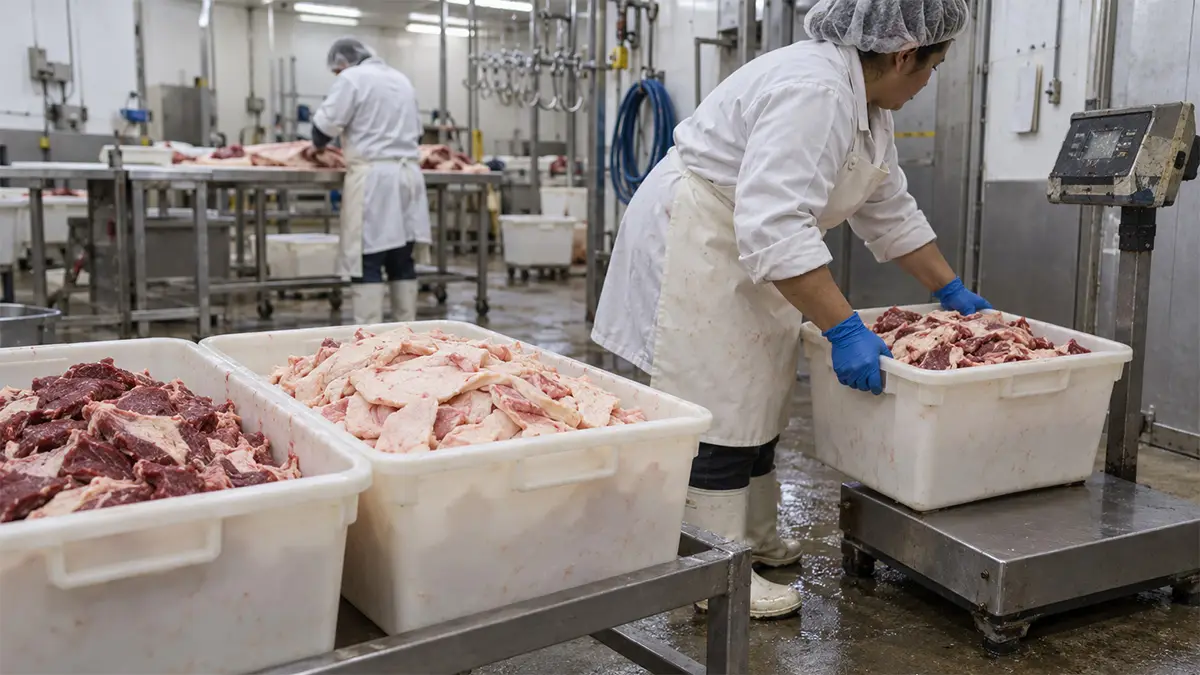
In a meat plant, a lot comes down to pounds. Every pound that leaves as sellable product earns something. Every pound lost to shrink, heavy trim, or sloppy cutting has already been paid for.
Following the pounds
The University of Wisconsin-Madison walks through a typical example. A 1,200-pound steer that dresses at 62% produces a 744-pound hot carcass. After 3.5% shrink in the cooler, it’s down to about 718 pounds. At a 67% cutting yield, that becomes roughly 481 pounds of packaged beef, or about 40% of the live animal.
The University of Nebraska-Lincoln makes the same point with heavier cattle: a 1,400-pound animal yields a hot carcass of about 880 pounds.
Where yield slips
Some loss is out of your hands. Fatter, lighter-muscled cattle yield less, and boneless cuts weigh less than bone-in. But plenty is within your control.
- Cooler shrink. A carcass can lose 2% to 5% of its weight in the first day as it chills. Temperature, airflow, and hang time all play a part.
- Trim. When cutters trim differently, sellable lean ends up in the fat barrel.
- Grind. Measuring your lean point instead of eyeballing it keeps you from giving away lean.
If your plant is still on paper, use conservative yield and shrink numbers in your projections. A few points of optimism can make a plan look profitable when the plant won’t be.
What 1% is worth
On that 718-pound carcass, one point of cutting yield is about 7 pounds. Over 300 head a year, that’s roughly 2,150 pounds. At $6 a pound (use your own number), it’s close to $13,000.
Who keeps that money depends on how you sell. If you buy animals and sell the meat yourself, it’s yours. If you charge custom customers by hanging weight, the extra pounds go home with them. That still matters, because a customer who gets more meat back is a customer who comes back.
Measure first
Record hot and chilled weights on every carcass, and finished pounds by carcass or by day. Compare cutters and weeks, and look for the outliers. A few weeks of numbers will show where the pounds are going.
Protein Performance Group brings meat science and economics to the same table. We help processors track yield, find where the pounds are going, and put a dollar figure on fixing it. We also help new projects build yield assumptions that hold up once the doors open. If you want a clearer look at your numbers, reach out.